

What does your tattoo mean?

I got a tattoo last year, my only one so far, and almost everyone who sees it for the first time, quizzes me about it. Tattoos are always a conversation starter. Among the people who ask about it I’ve noticed two kinds. The minority of those who ask where I got it or how long it took and the majority of those who ask what it means.
Usually the second kind are the ones who don’t have a tattoo themselves. And when I try to answer by explaining my tattoo, I quickly get interrupted. They say they can see what it is, what they’re curious about is what it means. Often they’re looking for a cool story about the values or beliefs that the tattoo symbolises. I don’t have such a story.
I believe this expectation that a tattoo must have a profound origin has got something to do with how people fundamentally perceive a tattoo. Let’s unravel this.

There are two generally accepted ideas about tattoos.
Getting a tattoo is painful.
I’ve noticed that people who haven’t gotten a tattoo always overestimate the pain involved. I myself was pleasantly surprised when my tattoo artist began and I barely felt anything.A tattoo is permanent.
You will carry it on your skin forever. Of course no one who gets a tattoo even considers for a moment that they could want to get it removed one day.
Given these two criteria a tattoo qualifies as a commitment one has made. Now the question is, can one commit to something without having a preceding significant personal meaning attached to it. Wait, what does meaning even mean here?
I’ll try to define the word in this context. Meaning can be understood as the combination of beliefs, values and narrative that influenced the person to imprint the visual on their body. It is not the mere explanation nor an interpretation of the visual. So the question ‘what does your tattoo mean?’ Is better phrased as ‘what is the meaning behind your tattoo?’ or, ‘what was the thinking that is symbolised in this visual representation.’
With this explanation in mind if we take a deeper look at the question, we see that it comes with a presupposition that tattoos have meaning. I.e. ‘Tattoos have meaning, what is the meaning of yours?’
The semantics of such phrasing is reflective of the fundamentally held belief that tattoos indeed have meaning.
Do tattoos have meaning?
I do not doubt the significance that tattoos hold for people. Getting a tattoo is often a turning point for many. It can be the first time someone gets to exercise individual authority over their body. It can be empowering.
To begin to answer the question around meaning and tattoos, let’s take a quick look at the historical context of tattoos.
The practice of tattooing developed independently in cultures all over the world. There is evidence that suggests that it is at least 5000 years old. Various cultures had different uses for tattooing. The ancient Greeks and Romans tattooed slaves and criminals. In Polynesian cultures, each tattoo told a story of ancestry, societal status, and accomplishments. The ancient indigenous people of North America, South east Asia and North Africa all had their own uses for tattoos.
The commonality that can be observed among all these is that the tattoo was used as a group identifier. To brand others as outcasts or to mark themselves as belonging to a certain sect.
But today tattoos are in the mainstream of a cultural globalization. And along with their connotation of identity, spirituality and heritage, they are now expressions of individuality.
I propose the following scale to understand tattoos and their meaning.
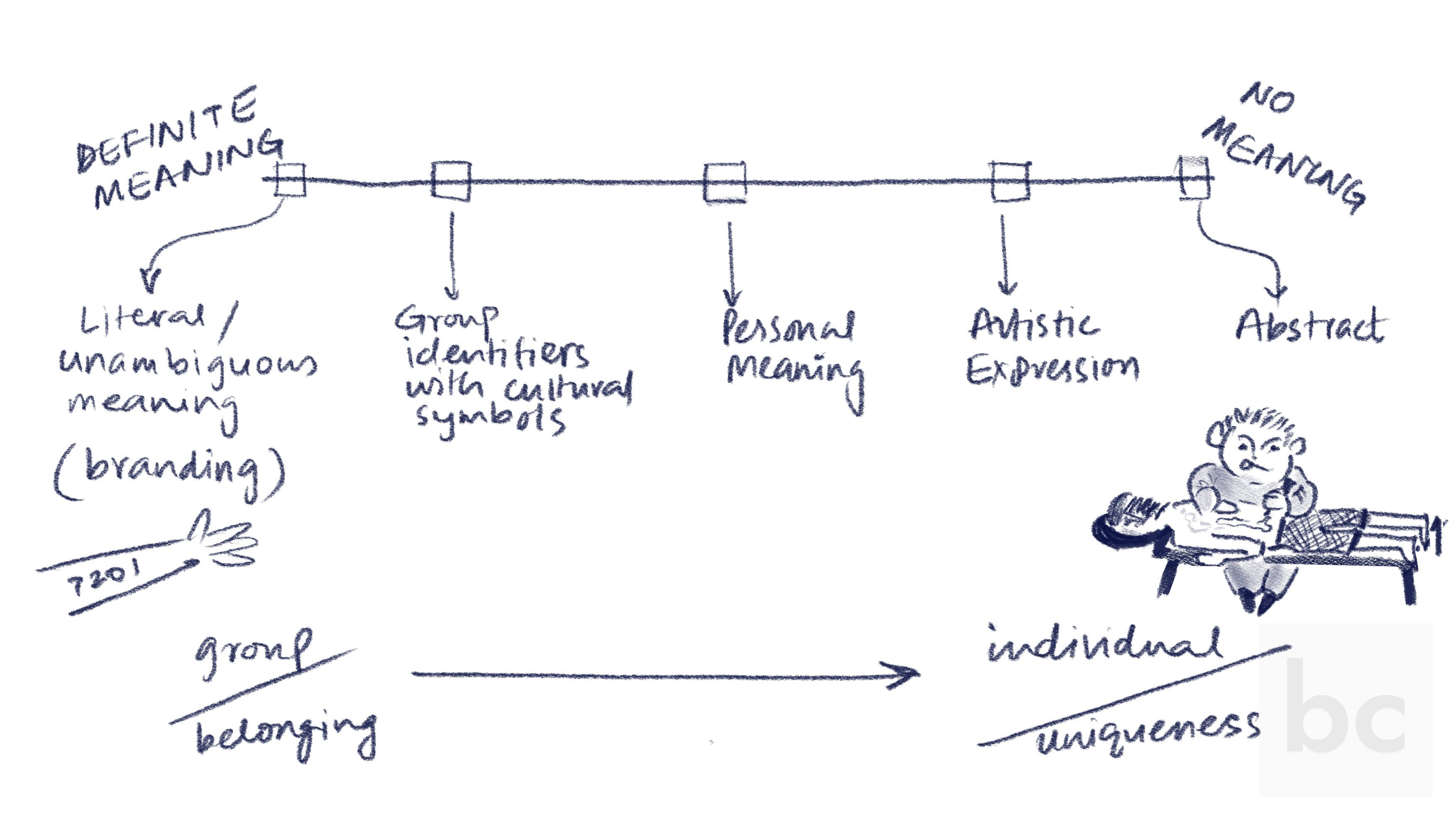
Tattoos with a clear, unambiguous definition fall towards the left end. As we move towards the right an objective definition changes into a personal meaning. Further towards the right end as it loses meaning, it moves into the individual sphere. Here the tattoo becomes an expression of the person’s individuality.
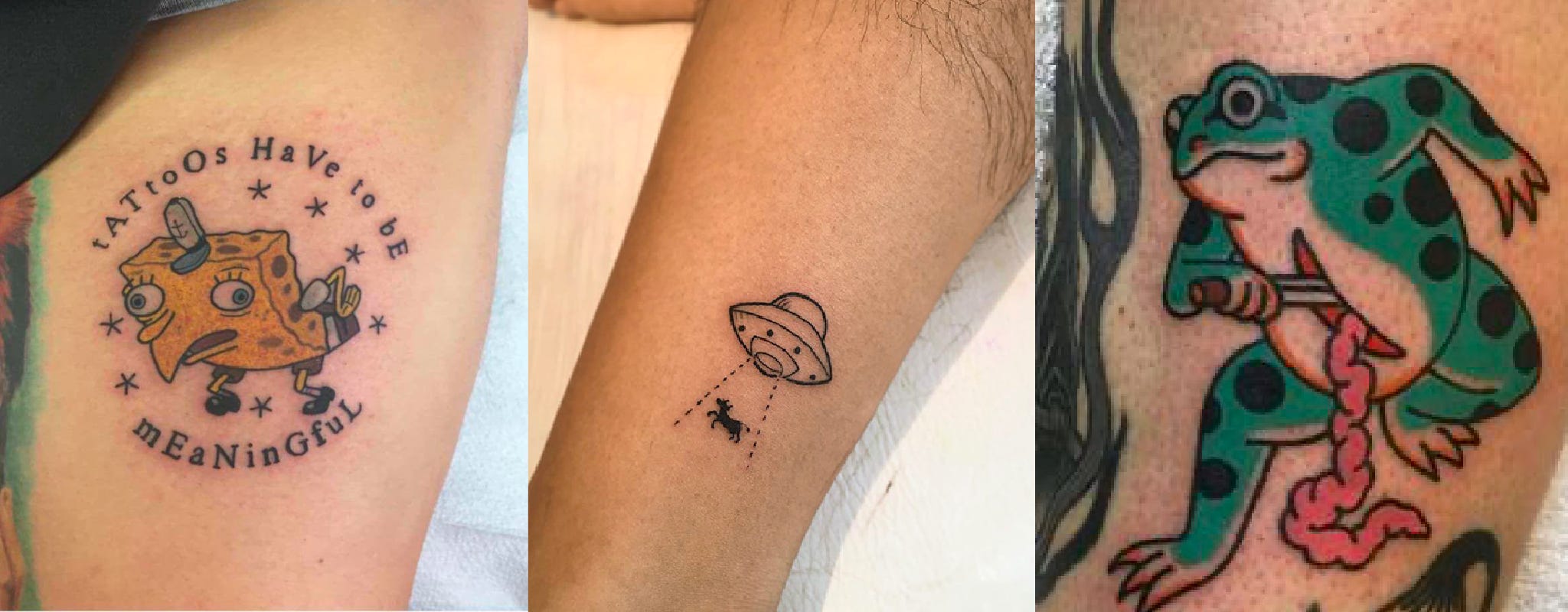
Some tattoos that are purely artistic expressions don’t have a meaning. And such tattoos are on the rise. Tattoos of memes, meta memes, gibberish Lorem ipsum text and things that you probably never even imagined.
The story behind my tattoo
Growing up in a town in India, tattoos were very uncommon. No one in my family had one. The only tattoos that I occasionally saw were the symmetric line art patterns that women of the Banjara people wore. I learnt about tattoos from TV. I loved Kat Von D’s Miami Ink.
In that show everyone who came to the tattoo shop had a story. They wanted to memorialise something in their life in the form of a tattoo. That show shaped my perception towards getting inked.
The thought of getting a tattoo stayed with me as I grew up and when I moved out and started working, I felt the freedom to make it happen.
I had the money and intent. But I didn’t have a story. So, it took a backseat. Over the years, I began to appreciate tattoos as a form of art. Gradually I dropped the notion that tattoos need a meaning.
Looking back, I didn’t get a tattoo as long as I believed that they needed to have a meaning. This was a barrier. Once I let go of that idea, getting inked seemed so easy. Last year, when I was on a solo trip to Southeast Asia, I spoke to fellow travellers about their tattoos and used their inputs to work on an idea.
It started with something that I made on a lazy evening in Koh Tao. I kept adding details and over the next couple of weeks I made a version that I was happy with. When I was about to finish my trip, I walked into the highest rated tattoo shop in Hanoi. The tattoo artist worked with the idea I gave him and made improvements. Two days later I got inked.
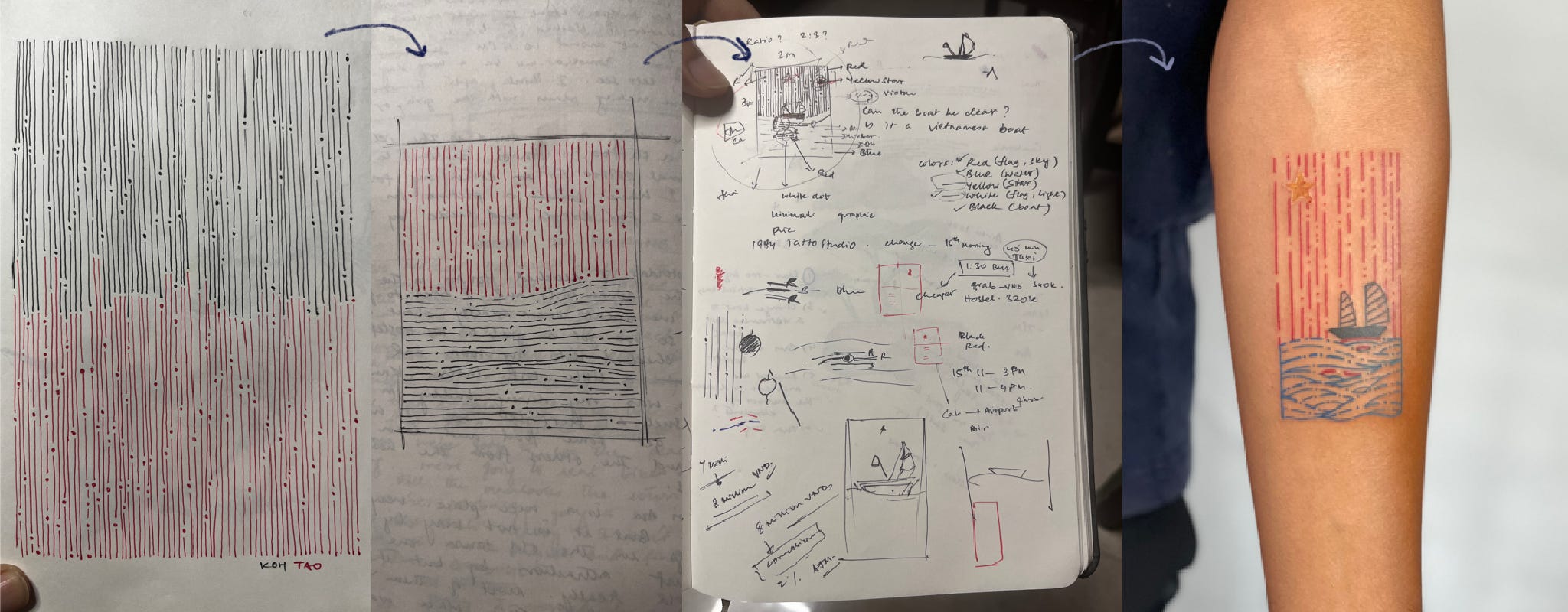
The tattoo artist did an excellent job and I felt nothing more than a pin prick. I’m still very happy with how it turned out. And most of all I thoroughly enjoyed the process.
So here’s the final word.
In a world where personal expression and individuality are increasingly celebrated, tattoos have transitioned from symbols of communal identity to canvases of personal narratives or, at times, simply art.
For some, a tattoo encapsulates a poignant life event or belief, while for others, like myself, the journey of getting a tattoo itself becomes the story. This evolution of tattoo culture underscores the idea that just as art can be open to interpretation or exist simply for its beauty, so too can the ink we choose to adorn our bodies with.
I’d love to know if your tattoo has a meaning, leave a comment!
This Week’s Recommendation 🎸
Masayoshi Takanaka is a Japanese guitarist, composer and producer. ‘All of Me’, released in 1979, is a compilation album of his early work. The album is a fusion of jazz, funk, and rock elements, showcasing Takanaka's ability to seamlessly blend genres and create a sound that's both unique and engaging. The music is perfect background music to liven up the mood while working or cooking. It’s all in Japanese so don’t worry about getting distracted.